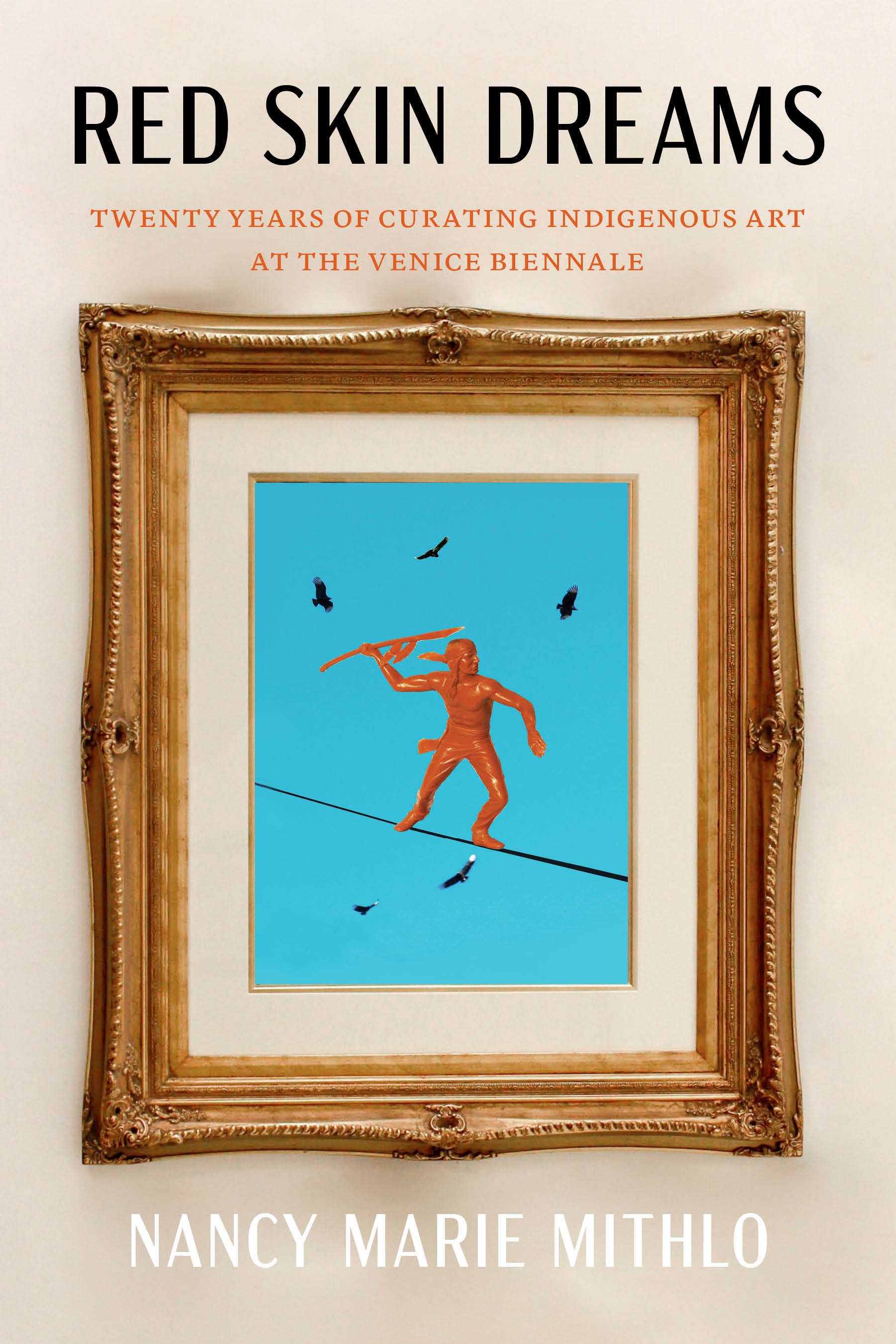
Cover Image: Shelley Niro. The Show Off, digital image, 2017.
Courtesy of the Artist.
“Red Skin Dreams”: Twenty Years of Curating Indigenous Art at the Venice Biennale
University of Nebraska Press, Matt Bokovoy, Senior Acquisitions Editor

ORDER from University of Nebraska Press HERE
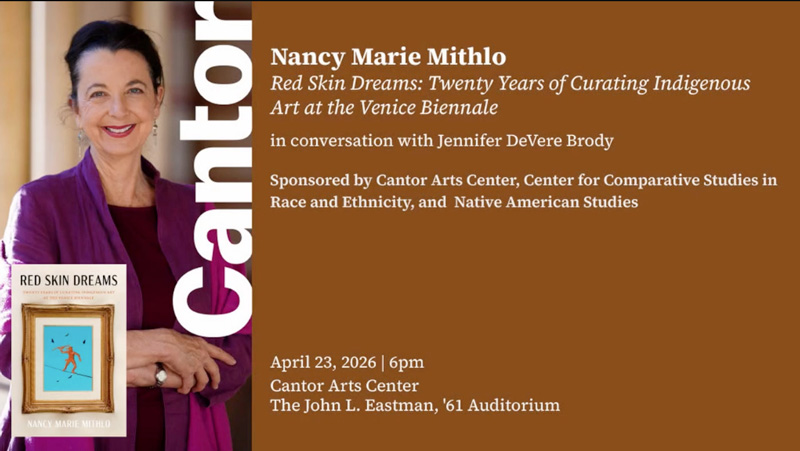
Cantor Art Center Book Talk on Youtube
“Red Skin Dreams” documents and theorizes the presentation of contemporary American Indian art exhibits at the Venice Biennale from 1997-2017. The story is conveyed through memoir and storytelling as I document the nine exhibits I helped to lead over a twenty-year period. The improbable and messy business of staging international exhibits that were non-institutional, non-commercial and anti-hierarchical involved collaborators from across the globe—Canada, Australia, New Zealand, Switzerland, England, Norway, Germany, as well as Italy. These connections were made through Indigenous networks, institutions, and relationships, not the prestigious galleries, museums and art collectors that typically decide who is represented and where. Our presence-making exposed the fiction that only those “in the middle of things” had access to exhibition.

PRE-ORDER from Birchbark Books HERE
 Instagram page for book @redskindreamsthebook
Recommended by HÉLÈNE B. DUCROS
In her fascinating and also moving book, Red Skin Dreams: Twenty Years of Curating Indigenous Art at the Venice Biennale, Nancy Marie Mithlo, a member of the Fort Sill Chiricahua Warm Springs Apache tribe, splendidly chronicles her two decades (1997 – 2017) of bringing American Native art exhibitions to the world’s oldest and largest venue for contemporary art: the renowned and elitist Venice Biennale. The book is as much about her personal story navigating the changing politics of the Biennale as about the artists who fill the pages of her narrative, also present in photographs throughout the volume, which gives the reader an immediate feeling of proximity and relationship. Mithlo describes her tribulations negotiating a global arts system that has offered her both success and failure, excitement and disappointment. Through her nine curated shows she calls “strategically subversive, endlessly creative, and generative,” she was able to bring together community storytelling and the visual arts and link the Old World with the so-called New World. Drawing attention to networks of art consumption in an international contemporary art market plagued with corruption, appropriation, patriarchalism, and nationalist dynamics, she also operates a parallel between the Biennale and the imperial project of past essentializing world’s fairs (is the Biennale an “outgrowth of imperialism?” she asks). She further laments the limited role of curators and scholars in the circulation of artworks, as dealers and collectors hoard market power in institutional arrangements that decontextualize art, often excluding plural Indigenous knowledge, participatory practices, and collective—albeit sometimes divided—action.
Mithlo envisages her mission as a way to disenclave Indigenous arts from the US Southwest saturated and localized art scene. Her effort challenges a global artistic community that has alienated Native arts and artists, rendering them irrelevant, geographically assigned, and unseen because by nature non-individualistic and based on kinship values. As she shakes up the international arts exhibition sphere, she questions Indigeneity itself, in all its diversity, sensibilities, positionings, lineages, dreamings, and unique land-based histories. She considers what it means to be at the same time seemingly included (present at the Biennale) and excluded (invisibilized) from arts circles, and by extension from a dominant global society. Her quest for Native arts to be recognized in Venice stands as an inspiration for transnational Indigenous aesthetics to expand in spite of a system that spurs commercial dispossession. Engaging with notions of authenticity, authentication, essentialized identity, transnationalism, objectification, and agency, she reveals a normed globalized relational web that has shaped an external gaze onto American Natives, locking them into a geographically and temporally static situatedness. In contrast, she makes them into global citizens, creating pathways for future generations of Indigenous artists, from America and elsewhere, to continue to instill an ideology of belonging and build collective strength in an international art conversation that needs refreshing. No need to be an art specialist or a scholar of Indigeneity or museography to appreciate Mithlo’s evocative writing, which draws the reader into the intimate stories of the artists-protagonists, although the book will naturally appeal to researchers in museum studies, Indigenous studies, cultural geography, or anthropology.
Ceremonial - Contemporary Native Art Exhibition, 1999 Venice Biennale.
Video by Gabriel Lopez Shaw. Including original music by Matthew Andrae.